
What Is Betfair Trading?
Betfair trading is buying and selling prices on the betting exchange, similar to trading stocks. You are not just placing a bet and waiting for the result. Instead, you can open a position at one price and close it later at another, locking in profit or reducing risk.
On Betfair, you trade against other people, not a bookmaker. That means the market is driven by supply and demand, and prices move as opinions change. Traders aim to profit from these price movements and from building balanced positions.
Back vs Lay: The Core Concepts
Every exchange trade starts with understanding back and lay bets:
- Back = you are betting on an outcome to happen.
- Lay = you are betting against an outcome (acting like the bookmaker).
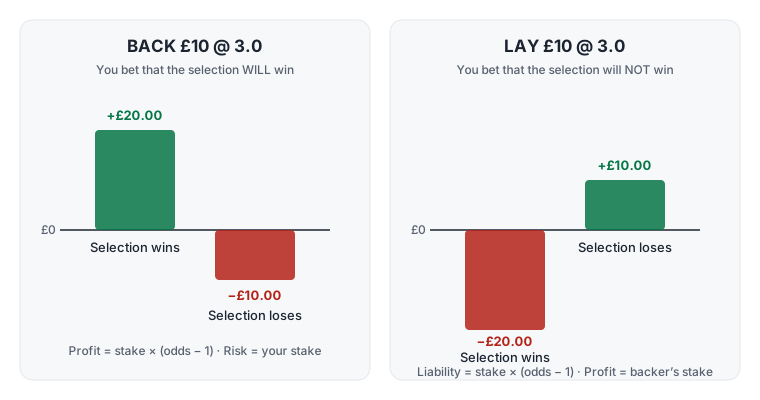
A simple trade might involve backing a team at 3.0 and laying it later at 2.5 if the price shortens. The difference between the two prices is your edge.
Your First Trade on Paper, Step by Step
Before risking anything, work one full trade through on paper. Here is the classic back-to-lay cycle using the same numbers you can verify in the hedge calculator:
| Step | Action | If selection wins | If selection loses |
|---|---|---|---|
| 1. Open | Back £10 @ 3.0 | +£20.00 | −£10.00 |
| 2. Price shortens | Market moves 3.0 → 2.5 | No change yet — your position is just worth more | |
| 3. Close | Lay £12 @ 2.5 | +£20.00 − £18.00 = +£2.00 | +£12.00 − £10.00 = +£2.00 |
The lay stake of £12 comes from £10 × 3.0 ÷ 2.5. Commission then comes off the £2 profit — at 2% you keep £1.96. The same maths in reverse (price drifts instead of shortens) produces an equal loss on both outcomes, which is why entry price matters more than anything else.
Three Numbers to Check Before Every Trade
1. Implied probability
Exchange odds are a direct reflection of implied probability:
impliedProbability = 1 / decimalOddsOdds of 3.0 mean the market rates the outcome at 33.3%. If your own estimate is meaningfully higher, the price is backable; if it is lower, the price is layable. The odds converter does this instantly.
2. Liability
On the lay side your downside is not your stake — it is your liability, which grows with the odds. Laying £10 at 8.0 risks £70. Check it with the lay liability calculator before you place anything.
3. Commission
Betfair charges commission on winning trades only, so your true profit is smaller than the raw difference between prices. A trade that looks like +£2.00 is +£1.96 at 2% commission — small per trade, decisive over hundreds of trades.
Greening Up: Locking in Profit
“Greening up” means spreading your profit across all outcomes so you win the same amount regardless of what happens — exactly what step 3 of the paper trade above does. This is the key habit that separates trading from gambling.
The back/lay hedging guide covers when to green up and when letting a position run is actually the better expected-value choice.
Bankroll Basics and the Mistakes That End Beginners
Trading is a long-term game. Protecting your bankroll is more important than winning any single trade. Stick to consistent stake sizing, avoid chasing losses, and never risk money you cannot afford to lose. If you want a structured staking method, start with the Kelly staking guide — and use a quarter or half fraction, not full Kelly.
The mistakes that most often wipe out new traders, roughly in order:
- No exit plan. Opening a position without deciding in advance where you will close it, then reacting emotionally to the price.
- Ignoring liability. Laying at high odds "because it probably won't win" and discovering the downside is 5–10× the stake.
- Ignoring commission. An edge that exists before commission can vanish after it.
- Over-staking. Using so much of the bankroll per market that a normal losing run is fatal.
- Confusing strike rate with profit. Winning 80% of trades means nothing if the 20% of losers are bigger than all the winners combined.
A Sensible First Week
- Days 1–2: Paper trade only. Pick a liquid market, write down your entry and planned exit, and work the numbers in the hedge calculator.
- Days 3–4: Learn the risk side. Read the lay liability guide and check the liability on every lay you would have placed.
- Days 5–6: Learn to price. Work through the break-even odds guide and the expected value guide so you can tell a good price from a tempting one.
- Day 7: If you trade with real money, use minimum stakes (£2 on most markets) and treat it as paid tuition, not income.
Prefer an offline copy of this guide?
Related calculators
- Lay liability calculator — Understand your maximum exposure before you lay.
- Back/lay hedge calculator — Green up positions and balance profit across outcomes.
- Expected value calculator — Check if your edge is positive over the long run.
- Kelly staking calculator — Size stakes responsibly for steady growth.
- Odds converter — Switch between fractional, decimal, and implied probability.