
What Is Back/Lay Hedging?
Back/lay hedging is the process of taking a second bet in the opposite direction after the market has moved, in order to smooth or lock in a profit. The classic examples are:
- Back first, then lay lower: back at a high price, lay at a shorter price.
- Lay first, then back higher: lay at a low price, back at a bigger price after a drift.
In both cases, the price movement creates an opportunity. A hedging calculator helps you size the second bet so that your overall position is balanced and you understand your profit in each scenario.
Why Traders Hedge on Betfair
Traders do not hedge because they can predict every twist of a market. They hedge to manage risk and bank profits. Common reasons include:
- Locking in profit: when a selection shortens or drifts in your favour and you want to secure a guaranteed return.
- Reducing downside: when new information makes a position less attractive and you want to limit potential loss.
- Managing emotion: a small but guaranteed profit can be easier to live with than a large but volatile open trade.
Hedging is not compulsory, and there is no rule that you must always green up. It is simply one more tool you can apply when the numbers justify it.
Back First, Then Lay to Hedge
A common pattern on Betfair is to back a selection before the off and then lay it at shorter odds if the price comes in. For example:
- You back £20 at odds of 5.0
- The price shortens to 3.0 before the start
At this point you could simply let the bet run, or you could place a lay bet at 3.0. The question is: what lay stake gives you a neat, level profit whether the selection wins or loses?
That is where a back/lay hedging calculator comes in. You enter the details of your original back bet (stake and odds), the new lay price, and your commission rate. The calculator returns the lay stake required to balance your position and shows your profit if the selection wins or loses.
Lay First, Then Back to Hedge
You can also trade in the opposite direction. Suppose you expect a favourite to drift in price:
- You lay £25 at odds of 2.6
- Later, the price drifts to 3.4
If the drift matches your expectations, you may want to back the same selection at the higher price to lock in a profit or reduce risk. Again, the challenge is finding the right back stake to smooth your position.
A hedging calculator reverses the logic: you enter the initial lay stake and odds, the later back price, and your commission rate. It then calculates the back stake and shows your profit in both outcomes.
Using the Smarter Trades Back/Lay Hedging Calculator
The Smarter Trades hedging tool is fully browser-based and designed specifically for exchange traders. You can try it on the main calculators page: Open the Back/Lay Hedge Calculator.
It supports both “back first, then lay” and “lay first, then back” patterns. You simply:
- Select the type of trade (back→lay or lay→back).
- Enter your initial stake and odds.
- Enter the new odds at which you plan to hedge.
- Provide your exchange commission rate.
- Press calculate to see the hedge stake and resulting profit figures.
The calculator shows approximate net profit after commission, reflecting how exchanges charge fees only on winning sides of the market.
Worked Example: Greening Up a Pre-Match Trade
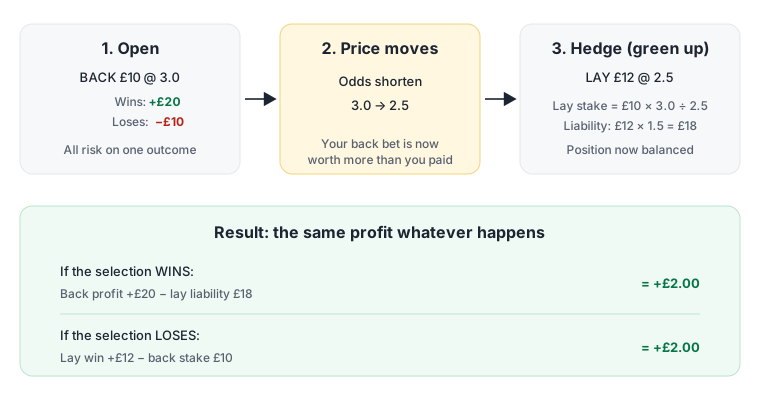
Imagine you back a football team at odds of 3.5 for £30, expecting the price to shorten before kick-off. The market moves in your favour and the odds come into 2.6. You now want to take some risk off the table.
By plugging those numbers into the Smarter Trades hedging calculator, you get a suggested lay stake. Once you place that lay bet, your position becomes:
- Profit if the team wins: roughly the same figure (after commission)
- Profit if the team does not win: a smaller but positive amount
You have effectively turned a directional bet into a more neutral trading outcome, banking profit from the price movement itself rather than the match result.
Things to Watch Out For When Hedging
1. Market Liquidity
If a market is thin, you may not be able to get your full hedge stake matched at the price you want. In that case, your final position may be slightly uneven. Always pay attention to the available volume at each price before relying on a calculator output.
2. In-Play Volatility
In-play markets can move extremely quickly. There is no guarantee that the odds shown a second ago will still be available by the time you click. Hedging in-play is possible, but you should assume some slippage and avoid oversized positions that require perfect execution.
3. Over-Hedging
It is easy to over-hedge and give away more upside than necessary. Not every small price movement must be traded. Many successful traders set predefined rules, such as only hedging once a minimum profit target is reached or when their read on the event has changed significantly.
Should You Always Green Up?
The idea of a guaranteed profit is emotionally appealing, but hedging is not automatically the “correct” choice. If your original bet is still value at the new odds, hedging might actually reduce your long-term expected return. On the other hand, if you are uncomfortable with the risk or feel your edge has disappeared, banking a smaller, certain profit can be the better decision.
The key is to be consistent. Decide when you will hedge in advance – for example, at a certain profit level, or when specific in-play events happen – and use the calculator to execute that plan cleanly.
Frequently Asked Questions
Does hedging guarantee I will make money overall?
No. Hedging can lock in a profit on a particular trade when the market has already moved in your favour. It cannot fix a long-term strategy that lacks an edge. Over a large sample of bets, you still need solid selection, staking and discipline.
Can I hedge across different markets?
Yes, you can sometimes hedge in related markets – for example, balancing a match odds position with a correct score bet. However, the relationship between markets is rarely perfect, and the maths becomes more complex than a simple back/lay on the same selection. The Smarter Trades hedging calculator is designed for direct hedges on the same runner.
Is it better to hedge early or late?
There is no universal answer. Hedging earlier usually means you give up some potential upside but reduce risk more quickly. Hedging later may increase your average profit when it works, but with a greater chance of the market swinging back before you can act. Your decision should match your risk tolerance and trading style.
How do I access the Smarter Trades hedging calculator?
You can find it on the main tools page: Smarter Trades Back/Lay Hedge Calculator. It is free, runs in your browser and does not require a login.
Does using a calculator make hedging “safe”?
A calculator does not remove market risk, but it does remove arithmetic errors. It ensures your stakes match the position you intend to take, so you can concentrate on the trading decision itself rather than worrying about mis-typing a figure in the heat of the moment.
Related calculators
- Back/lay hedge calculator — Calculate stakes to green up.
- Lay liability calculator — Review downside before hedging.
- Expected value calculator — Validate if the hedge locks in value.
- Odds converter — Convert prices to implied probability.
- Kelly staking calculator — Size stakes for long-term consistency.